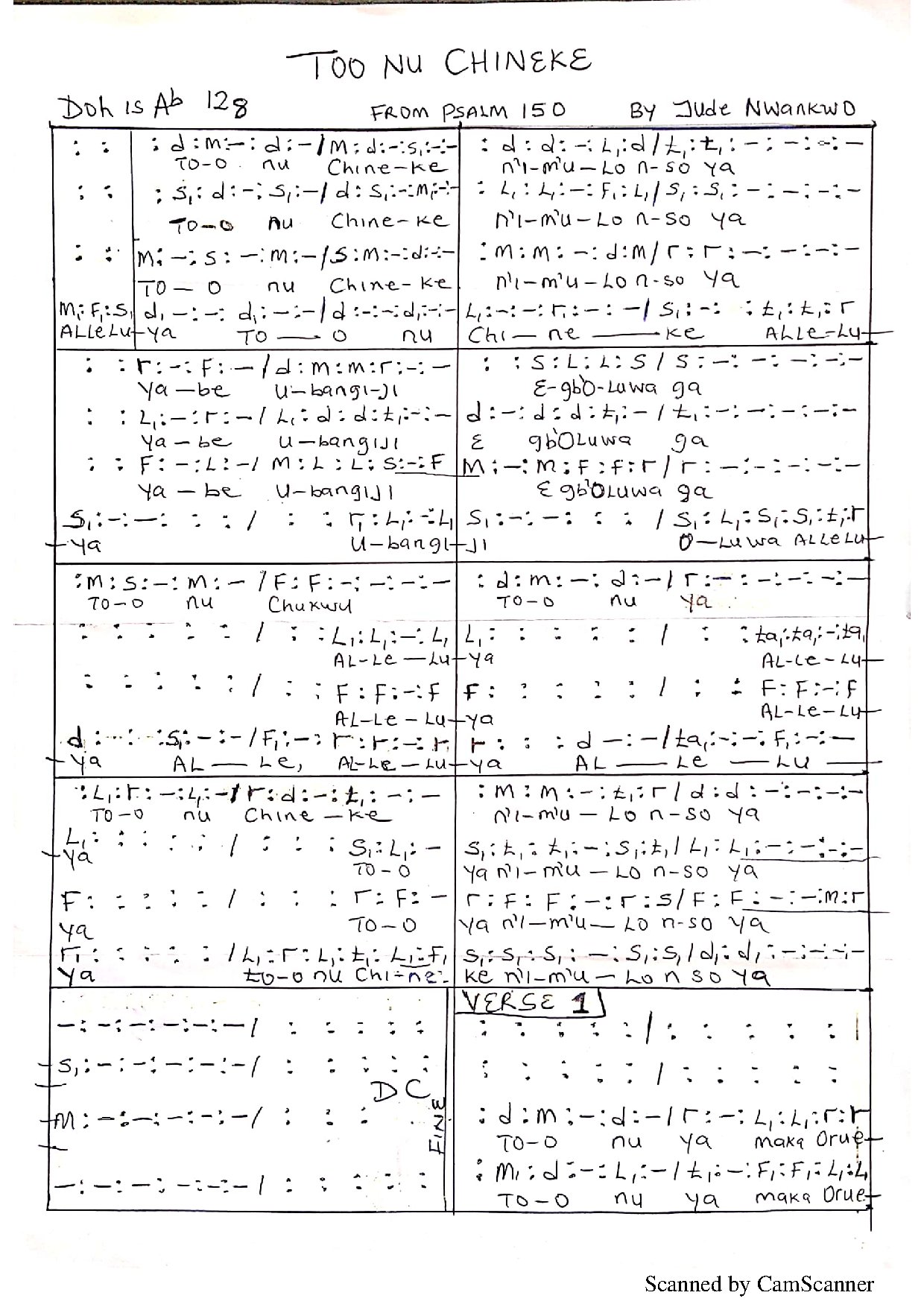
Too Nu Chineke
Solfa Notation • Celebrations, Entrance songs, Recessional / Dismissal Hymns, Hymns
Subscribed as
Want Sunday picks sent to another address too?
Your choir should not be left out in what's trending
Sunday mass selections, psalms, and trending songs in your area — straight to your inbox.
Too Nu Chineke by Jude Nwankwo — Lyrics
About Too Nu Chineke
Jude Nwankwo’s "Too Nu Chineke" is a vibrant, unifying setting of Psalm 150 that brings the scriptural call to praise right into the heart of the Nigerian church. The song opens with the familiar command to praise God in His sanctuary, but quickly expands its reach, weaving Hausa ("Yabe Ubangiji") and Yoruba ("Ẹ gb'Oluwa ga") phrases into the primary Igbo text. It is a piece that immediately lifts the spirit of the congregation, making it a perfect choice for Entrance processions, joyful recessions, or any grand celebration in the liturgy.
As the verses unfold, the choir sings through the psalmist’s list of instruments—trumpets, harps, flutes, and resounding cymbals. The arrangement builds an infectious rhythm that naturally invites movement in the choir loft and the pews. The true climax of the piece arrives in the third verse, where the psalmist’s command for "everything that has breath" to praise the Lord is beautifully localized. The cantor calls out to the different peoples of Nigeria—the Yoruba, Hausa, Ijaw, Igbo, Calabar, Urhobo, Benin, and Idoma—with the choir responding in a unified shout of praise.
Singing this piece feels like gathering the whole nation under one roof for worship. It reminds us that our diverse languages and cultures are all instruments meant to glorify God. When the final chorus circles back, the combined voices and rhythms leave everyone with a profound sense of shared joy and thanksgiving.