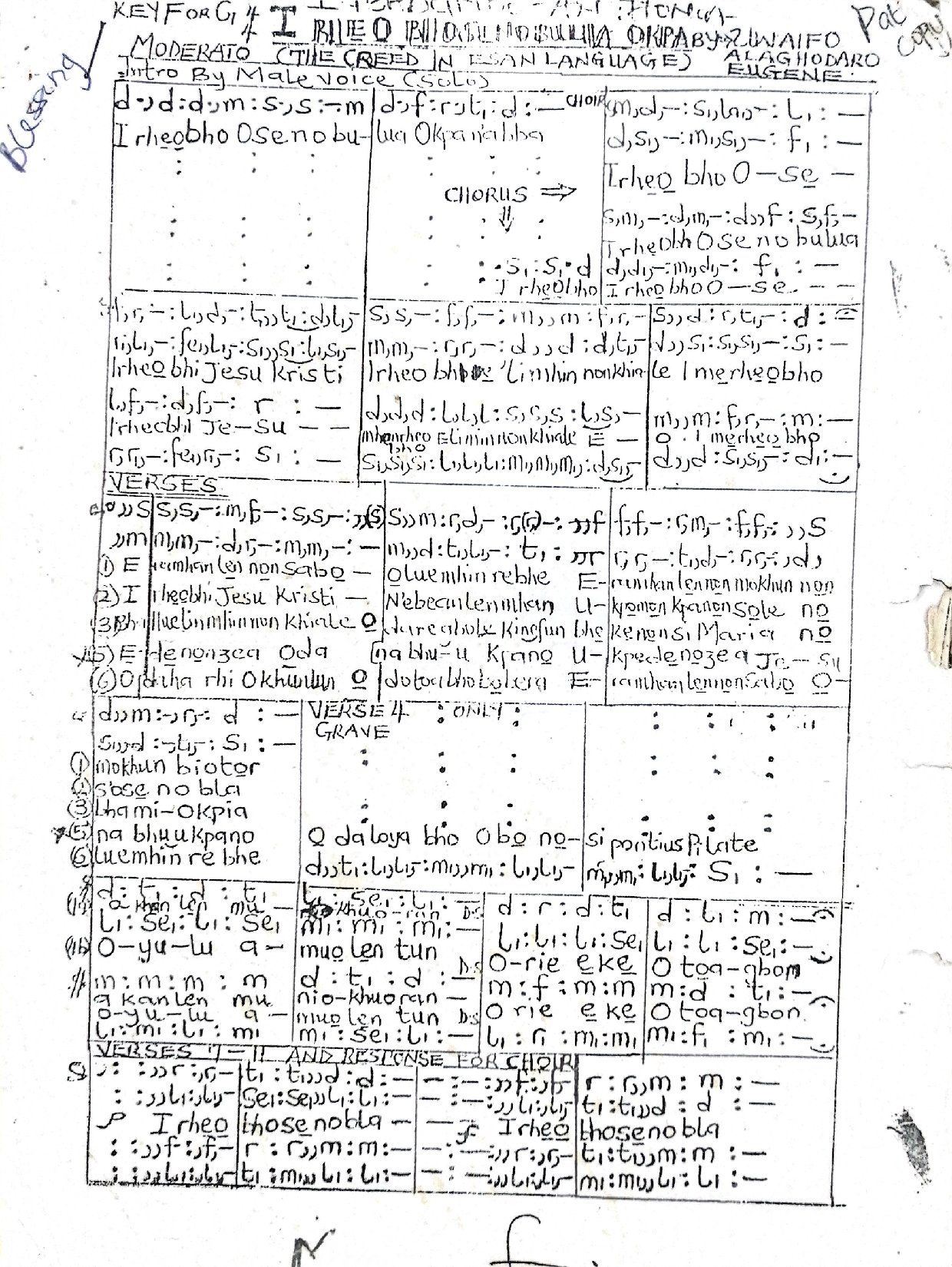
I RHE O BHOSENOBULUA OKPA - Choir Script PDF Thumbnail
Preview
0 0
9 downloads
Added Sep 28, 2025
Uploaded By: Choir PDFs
Format: Solfa
Language: Esan
Pages: 2 pages
I RHE O BHOSENOBULUA OKPA by Uwaifo Alaghodaro Eugene — Lyrics

[INTRO BY MALE VOICE (SOLO)] I rheo bho Osenobulua Okpa n'abba [CHORUS] I rheo bho Ose I rheo bho Osenobulua I rheo bho Ose I rheo bhi Jesu Kristi I rheo bho 'Limhin non khiale I rheo gbho mhan rheo Elimin non khiale Eo, I rheo gbho [VERSE 1] E kamhan (e) non sabo oluemhin rebhe Erun lian len len mokhun non mokhun biotor [VERSE 2] I rheo bhi Jesu Kristi Ne beamlen mhan Ukpon en kpan en sole no sbse no bla [VERSE 3] Bhi uluemhin mhin non khiale Otare abole kinefun bhe keno nsi Maria no lhamiOkpia [VERSE 4] EHe non zea Oda na bhuu kpano Ukpe de no ze a jisu na bhu ukpano
Read full lyrics

About I RHE O BHOSENOBULUA OKPA

This is a solemn and rhythmic setting of the Nicene Creed in the Esan language, composed by Uwaifo Alaghodaro Eugene. Titled "I Rhe O Bhosenobulua Okpa" (I believe in one God), the piece walks the congregation through the foundational truths of the Catholic faith, from the creation of heaven and earth to the resurrection of the dead.

The arrangement is structured to keep the choir and congregation engaged through a long text. A male soloist opens the profession of faith before the choir joins in a driving, repetitive chorus that anchors the piece. The verses are then chanted, with a special instruction for Verse 4—the section recounting Christ's passion and death under Pontius Pilate—to be sung "Grave" (solemnly), slowing the tempo and softening the instruments to reflect the weight of the crucifixion.

As the song progresses into the later articles of faith (the Holy Spirit, the Catholic Church, and the resurrection), the structure shifts to an intermittent cantor solo with the choir responding "I rheo lhose no bla." It finally builds to a vigorous, crescendoing "Ise" (Amen), bringing the profession of faith to a joyful and resounding close. It is a beautiful example of how indigenous languages and musical forms can breathe fresh devotion into the ancient texts of the Mass.