This edition was prepared by Andrew Sims — free to download, print, rehearse and perform.
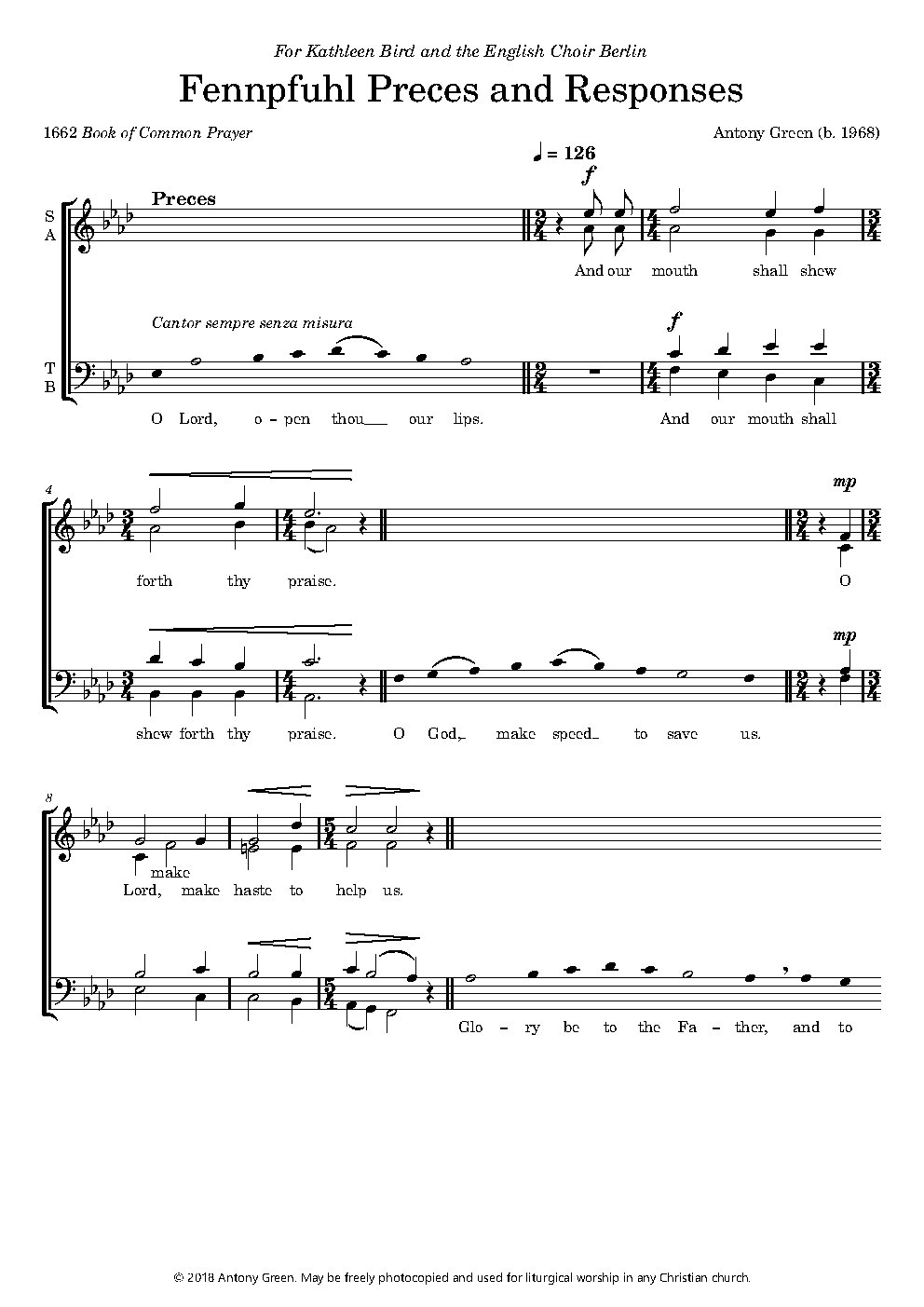
Fennpfuhl Preces and Responses
Staff Notation • Sacred, Preces and Responses
Preview
0
0
Subscribed as
Want Sunday picks sent to another address too?
Free weekly email
Your choir should not be left out in what's trending
Sunday mass selections, psalms, and trending songs in your area — straight to your inbox.
Fennpfuhl Preces and Responses by Antony Green — Lyrics
From the Book of Common Prayer, 1662
[First, the Preces are said/sung:]
[Priest.] O Lord, open thou our lips.
Answer. And our mouth shall show forth thy praise.
Priest. O God, make speed to save us.
Answer. O Lord, make haste to help us.
Priest. Glory be to the Father, and to the Son, and to the Holy Ghost;
Answer. As it was in the beginning, is now, and ever shall be, world without end. Amen.
Priest. Praise ye the Lord.
Answer. The Lord's Name be praised.
[After the Creed is said, the Responses:]
Priest. The Lord be with you.
Answer. And with thy spirit.
Minister. Let us pray. Lord, have mercy upon us. Christ, have mercy upon us. Lord, have mercy upon us.
[All.] OUR Father, which art in heaven, Hallowed be thy Name. Thy kingdom come. Thy will be done in earth, As it is in heaven. Give us this day our daily bread. And forgive us our trespasses, As we forgive them that trespass against us. And lead us not into temptation, But deliver us from evil. Amen.
Priest: O Lord, shew thy mercy upon us.
Answer. And grant us thy salvation.
Priest. O Lord, save the King.
Read full lyrics
About Fennpfuhl Preces and Responses
Antony Green's Preces and Responses set the familiar liturgy from the 1662 Book of Common Prayer for SATB choir. The music opens with a direct, declamatory style, setting the Priest's petitions and the choir's responses with clarity and purpose. The interplay between the sung lines is designed to create a sense of communal prayer. As the setting progresses, the texture shifts, allowing for moments of richer harmonic colour within the SATB voicing. The music serves the text, aiming for an accessible yet dignified presentation of these essential elements of English liturgical practice. The setting concludes with the Lord's Prayer, a central focus of congregational devotion.