This edition was prepared by Gerd Eichler — free to download, print, rehearse and perform.
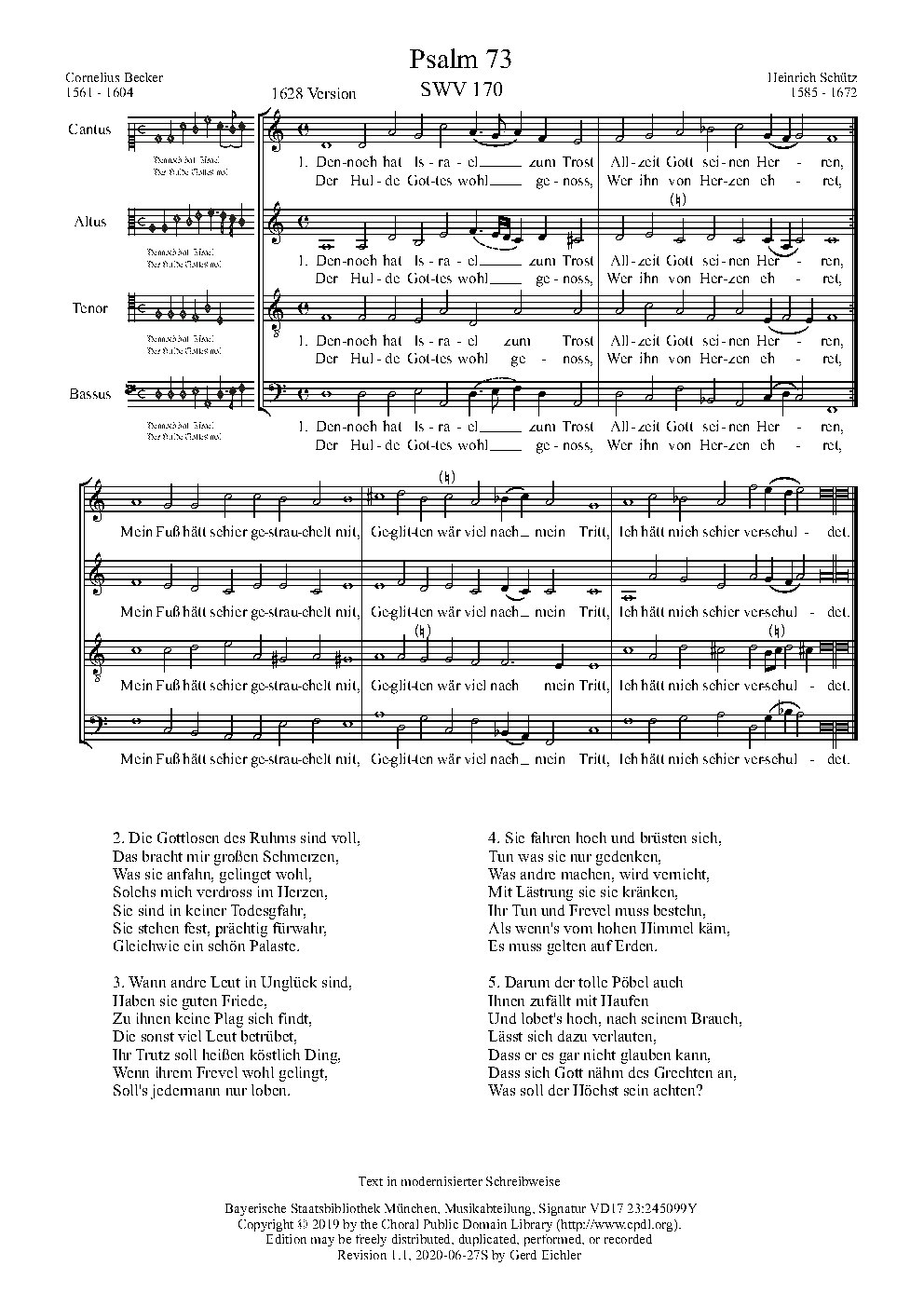
Dennoch hat Israel zum Trost, SWV 170
Staff Notation • Sacred, Hymns
Preview
0
0
5 editions of this piece
Different typesettings and voicings of the same work. This page shows the main edition; the others are below.
Subscribed as
Want Sunday picks sent to another address too?
Free weekly email
Your choir should not be left out in what's trending
Sunday mass selections, psalms, and trending songs in your area — straight to your inbox.
Dennoch hat Israel zum Trost, SWV 170 by Heinrich Schütz — Lyrics
Psalmus Asaph. Quam bonus Israël Deus, his qui recto sunt corde!
Mei autem pene moti sunt pedes, pene effusi sunt gressus mei:
quia zelavi super iniquos, pacem peccatorum videns.
Quia non est respectus morti eorum, et firmamentum in plaga eorum.
In labore hominum non sunt, et cum hominibus non flagellabuntur.
Ideo tenuit eos superbia; operti sunt iniquitate et impietate sua.
Prodiit quasi ex adipe iniquitas eorum; transierunt in affectum cordis.
Cogitaverunt et locuti sunt nequitiam; iniquitatem in excelso locuti sunt.
Posuerunt in caelum os suum, et lingua eorum transivit in terra.
Ideo convertetur populus meus hic, et dies pleni invenientur in eis.
Et dixerunt: Quomodo scit Deus, et si est scientia in excelso?
Ecce ipsi peccatores, et abundantes in saeculo obtinuerunt divitias.
Et dixi: Ergo sine causa justificavi cor meum, et lavi inter innocentes manus meas,
eEt fui flagellatus tota die, et castigatio mea in matutinis.
Si dicebam: Narrabo sic;
ecce nationem filiorum tuorum reprobavi.
Existimabam ut cognoscerem hoc; labor est ante me:
Read full lyrics
About Dennoch hat Israel zum Trost, SWV 170
Heinrich Schütz, a towering figure of early Baroque music, composed this motet for SATB choir. Setting a German translation of Psalm 73, the text explores the complex emotions of the psalmist, who grapples with envy at the apparent prosperity of the wicked. The Latin incipit, 'Psalmus Asaph', points to the origin of the text, revealing a profound meditation on justice and faith when confronted with injustice. Schütz's setting captures the dramatic tension and ultimate resolution found in the text, offering a powerful and contemplative experience for choirs and listeners alike.