This edition was prepared by Allen Garvin — free to download, print, rehearse and perform.
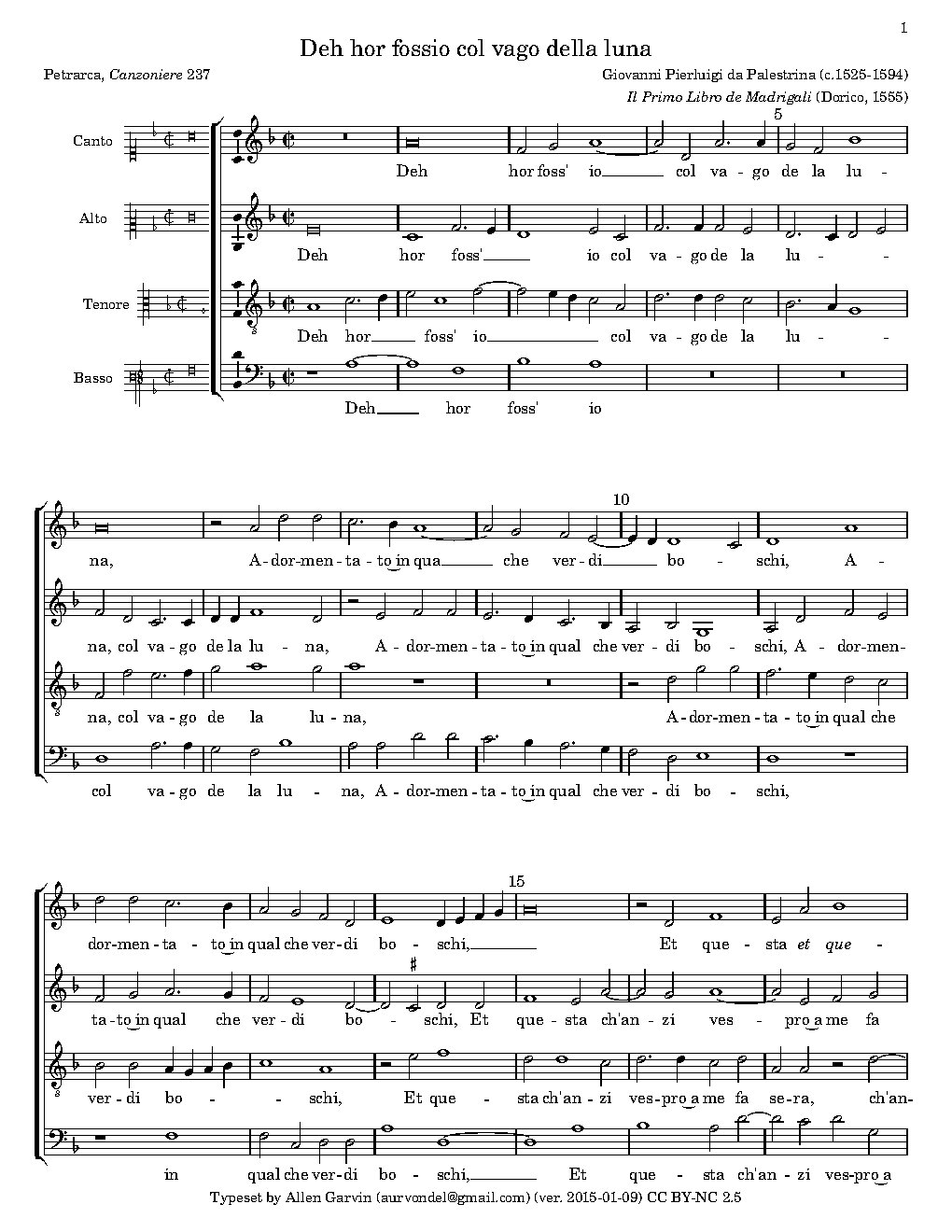
Deh hor fossio col vago della luna
Staff Notation • Secular, Madrigals
Preview
0
0
Subscribed as
Want Sunday picks sent to another address too?
Free weekly email
Your choir should not be left out in what's trending
Sunday mass selections, psalms, and trending songs in your area — straight to your inbox.
Deh hor fossio col vago della luna by Giovanni Pierluigi da Palestrina — Lyrics
Non à tanti animali il mar fra l'onde,
né lassú sopra 'l cerchio de la luna
vide mai tante stelle alcuna notte,
né tanti augelli albergan per li boschi,
né tant'erbe ebbe mai il campo né piaggia,
quant'à 'l io mio cor pensier' ciascuna sera.
Di dí in dí spero ormai l'ultima sera
che scevri in me dal vivo terren l'onde
et mi lasci dormire in qualche piaggia,
ché tanti affanni uom mai sotto la luna
non sofferse quant'io: sannolsi i boschi,
che sol vo ricercando giorno et notte.
Io non ebbi già mai tranquilla notte,
ma sospirando andai matino et sera,
poi ch'Amor femmi un cittadin de' boschi.
Ben fia, prima ch'i' posi, il mar senz'onde,
et la sua luce avrà 'l sol da la luna,
e i fior d'april morranno in ogni piaggia.
Consumando mi vo di piaggia in piaggia
el dí pensoso, poi piango la notte;
Read full lyrics
About Deh hor fossio col vago della luna
This setting of a Petrarchan sonnet for four voices (SAAT) expresses profound, all-consuming love. The opening lines compare the lover's constant thoughts to the sheer abundance of nature: the sea's creatures, the stars, the birds in the woods, and the plants on the fields. The text goes on to describe the lover's suffering, his sleepless nights, and his hope for an end to his torment, seeing his heart as a citizen of the woods. The music, by Palestrina, is a prime example of the secular Italian madrigal, a genre that flourished in the Renaissance and focused on capturing the emotional content of the text through intricate vocal writing and expressive harmony.