This edition was prepared by Barry Johnston — free to download, print, rehearse and perform.
Brownford
Staff Notation • Sacred
Preview
0
0
2 editions of this piece
Different typesettings and voicings of the same work. This page shows the main edition; the others are below.
SATB · Barry Johnston
Preview
Subscribed as
Want Sunday picks sent to another address too?
Free weekly email
Your choir should not be left out in what's trending
Sunday mass selections, psalms, and trending songs in your area — straight to your inbox.
Brownford by Samuel Holyoke — Lyrics
In finem. Psalmus David,
cum venit ad eum Nathan propheta, quando intravit ad Bethsabee.
Miserere mei, Deus, secundum magnam misericordiam tuam; et secundum multitudinem miserationum tuarum, dele iniquitatem meam.
Amplius lava me ab iniquitate mea: et a peccato meo munda me.
Quoniam iniquitatem meam ego cognosco, et peccatum meum contra me est semper.
Tibi soli peccavi, et malum coram te feci; ut justificeris in sermonibus tuis, et vincas cum judicaris.
Ecce enim in iniquitatibus conceptus sum: et in peccatis concepit me mater mea.
Ecce enim veritatem dilexisti; incerta et occulta sapientiae tuae manifestasti mihi.
Asperges me hyssopo, et mundabor; lavabis me, et super nivem dealbabor.
Auditui meo dabis gaudium et laetitiam: et exsultabunt ossa humiliata.
Averte faciem tuam a peccatis meis, et omnes iniquitates meas dele.
Read full lyrics
About Brownford
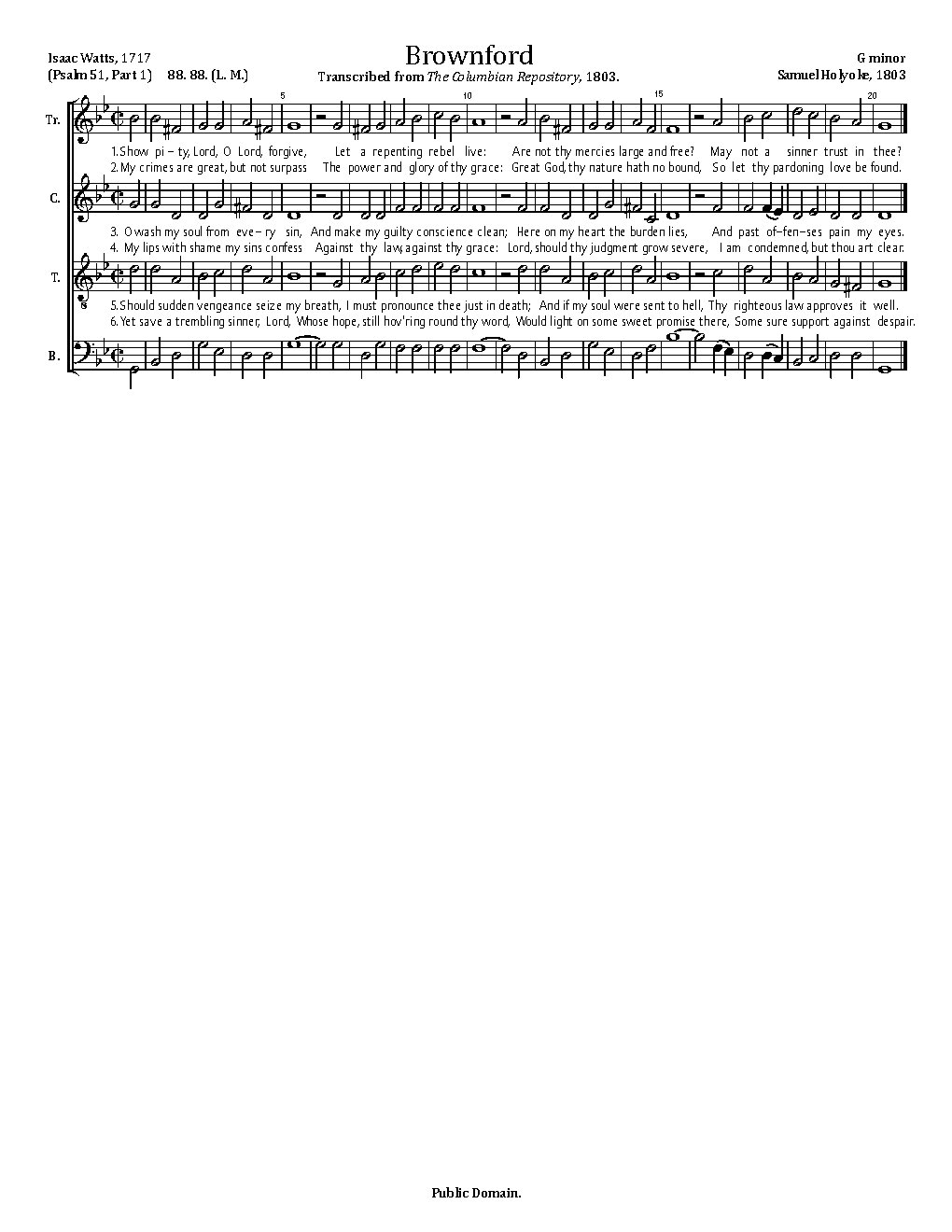
Samuel Holyoke’s setting of Brownford unfolds with a direct and heartfelt musical expression. The composer crafts a compelling SACRED work for SATB choir, drawing text from Psalm 50, the Miserere mei, Deus. This profound Latin text, a plea for divine mercy and cleansing from sin, is presented with a sympathetic musical line that allows the choir to explore its contrapuntal possibilities and rich harmonic colours. The translation into English ensures accessibility, allowing the choir and congregation to connect with the deep spiritual sentiments of the psalm. The interplay between the voices, whether in homophonic passages or more imitative sections, serves to underscore the penitential and ultimately hopeful nature of the text.